Showing posts with label palace. Show all posts

Tuesday, 27 May 2014

PORTUGAL'S BEST ROMANTIC HOTELS - QUINTA DAS LÁGRIMAS

http://www.travel-tailors.com/programas.php?pzone=4


On the site of a famous but tragic fourteenth-century love story between Prince Pedro and Inês de Castro, Quinta das Lágrimas Palace holds the secrets of this fateful affair. Providing a superb choice of accommodation, guests may choose from the magnificent 18th-century palace, the Garden residence or the slick modernity of the Spa building, and enjoy a nine-hole pitch-and-putt course, a lake, two pools and a Michelin-starred restaurant. 

Monday, 19 May 2014

PORTUGAL'S BEST ROMANTIC HOTELS - TIVOLI PALÁCIO DOS SETEAIS

http://www.travel-tailors.com/detalhado.php?i=375

In Sintra, in a land not so far away (30 minutes away from Lisbon by car), you can step into a fairy tale at the Palácio de Seteais. Built by the Dutch Council of Portugal in 1787 and an occasional residence for King João VI, this pin-drop peaceful 30-room hotel in the UNESCO World Heritage-protected costal region of Sintra is now an Arcadia for rest-seekers with a royal imagination.

A perfect white palace with trim, lemon tree dappled grounds, the Palácio de Seteais has a beautiful view over the heart-swelling 19th century architecture of Sintra and the lush, green mountains that shroud it. Playful Rococo-style murals by the 18th century painter Jean-Baptiste Pillement cover the walls of the hotel's several living rooms and restaurant, and any furniture that isn't surviving from that century has been styled to appear as though it is. The hotel closed for a year in 2009 to restore the murals to their former freshness and add tasteful mod-cons to the bedrooms - which are spacious with tall ceilings (if you stay on the ground floor), large sash windows to welcome the light, and beds so luxurious the tale of Rip Van Winkle would still be on-going had he stayed here.

Friday, 25 April 2014

SÃO BENTO PALACE

El Palácio de São Bento, un monasterio convertido en asamblea nacional

The original building of São Bento Palace was erected as a convent in 1598, but was later renovated as an enormous white Neoclassical building to become today's Portuguese Parliament, the Assembleia da República.

Tall columns support the pediment, and four statues on pedestals at the entrance represent Prudence, Strength, Justice, and Temperance.

The interior is grandiose, with marble pillars, Neoclassical statues, and other works of art. You may look inside when parliament is in session and debates are open to the public.

Monday, 24 March 2014

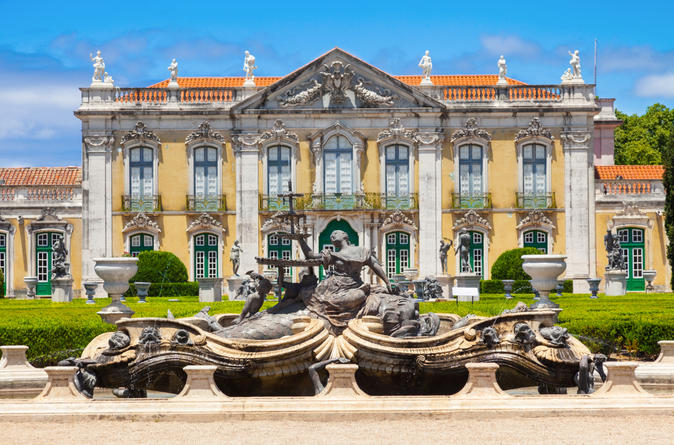
QUELUZ PALACE


www.traveltailors.com

The building of the palace, designed by Mateus Vicente de Oliveira, began in 1747. Although much smaller, it is frequently called the “Portuguese Versailles”, converted in the late 1700s to a royal summer residence. It’s surrounded by queen-of-hearts formal gardens, with oak-lined avenues, fountains (including the Fonte de Neptuno, ascribed to Italian master Bernini) and an azulejo lined canal where the royals went boating.

One of the wings of the Queluz Palace, the Dona Maria Pavilion, built between 1785 and 1792 and designed by Manuel Caetano de Sousa, is now a guest room for the exclusive use of foreign heads of state visiting Portugal.

Wednesday, 12 March 2014

THE AJUDA NATIONAL PALACE

www.traveltailors.com

In the first half of the 18th century, King John V planned to build a summer residence in the Ajuda hill. The building of this Royal Palace in this place, however, would take place only after the Earthquake of 1755 which destroyed the royal residence, Paço da Ribeira (Ribeira Palace), at the Terreiro do Paço (Palace Public Square).

Although this palace was never completed as planned due to the exile of the royal family in Brazil caused by the French invasion of Portugal, it is still one of Europe's most perfect romantic buildings.

Its interior is richly filled with furniture, tapestries, statues, and extravagant decorative arts, the result of unprecedented wealth in the 1700s when diamonds were discovered in the then Portuguese colony of Brazil.

The Palace was closed after the proclamation of the Republic in 1910 and reopened to the public in 1968, as a Museum. Gathering important collections from the 15th to the 20th century, mainly of decorative arts, the Palace is still used by the Portuguese State for official ceremonies.

Friday, 7 March 2014

VILA VIÇOSA

Vila Viçosa: mármoles y monasterios 


Everything around Vila Viçosa's peaceful broad streets lined with orange and lemon trees seems to be made of marble. Benches, pavements, framing of windows and doorways, and even the toilets in the bus station are made of this shining "white gold," the local marble from the enormous quarries outside the town. 

This was once home to the Bragança dynasty, whose kings ruled Portugal until it became a republic (Dom Carlos spent his last night here before his assassination). There is also a fine castle – one of the few nonmarble structures in town – an excellent archaeological museum, appealing churches and a friendly laid-back citizenry who are proud of their sparkling town.


Wednesday, 26 February 2014

NATIONAL PALACE OF MAFRA


 Biblioteca del Monasterio de Mafra, Portugal

Built in the 18th century by order of King João V (1689-1750) in fulfilment of a vow he made, to be blessed with an heir from his marriage to Maria Ana of Austria, or be cured of a serious illness, the Royal Convent and Palace of Mafra is the most important baroque monument in Portugal.

Mafra was King D. João VI’s favourite palace, who commissioned, at the end of the 18th century, mural paintings for several rooms and a new ensemble of six organs for the Basilica.

The monument also contains one of the most important European libraries, with a precious collection of 36.000 volumes, a synthesis of 18th century encyclopaedic knowledge.  

And it was from this palace that the last king of Portugal, Manuel II, left for exile on the 5th October 1910, following the proclamation of the Republic. The Royal Palace opens as a museum in 1911 under the name of Palácio Nacional de Mafra.

Friday, 31 January 2014

PALACE OF THE MARQUESSES OF FRONTEIRA


The Fronteira Palace, also known as the Palace of the Marquesses of Fronteira, is the privately owned property, but parts of it are opened to visits, and only on a tight schedule. 

The palace was built in 1640 for the first Marquis of Fronteira, Dom Joao de Mascarenhas (bestowed with the title of Marquis of Fronteira for his allegiance to King Pedro II of Portugal), in order to serve as hunting pavilion. At present, the oldest part of the castle complex refers to a 16th century chapel, but inside the castle, visitors can admire the stunning Battle Room (which stands out by the splendid tile panels due to which the room has been dubbed the Sistine Chapel of Tile Panels), as well as the Dining Room (with highlights like the paintings signed by Domingos Antonio de Sequeira). Outside the castle, visitors can search out the carefully arranged garden, which fills a surface of some 5.5 hectares, offering the spectacular scenery of the ingeniously cut hedges, tile panels and a statuary where sculptural works rendering the Kings of Portugal (chiefly, busts) are displayed.

Wednesday, 1 January 2014

PALÁCIO DA BOLSA, OPORTO


The Palácio da Bolsa (Stock Exchange Palace) is a monument in Oporto, built in the 19th century by the city’s Commercial Association in a neoclassical style with Palladian influences. It is located in the historical center of the city, which was declared World Heritage Site by the UNESCO.

St Francis Church
The palace is beside the St. Francis Church, which was part of the St. Francis Convent, from the 13th century. But due to a fire in 1832, during the Portuguese Civil War, the cloisters of the convent were destroyed and the church was the only part of the complex that remained. In 1841, Queen Mary II, winner of the Civil War, donated the convent ruins to the merchants of the city, who used them to build the Commercial Association. By 1850 the palace was already finished, but the interior decoration was only completed in 1910.


The most well-known room of the palace is the Arab Room, built between 1862 and 1886, decorated in an exotic Moorish Revival style and used as a reception hall for heads of state visiting the city of Oporto.


Visit Oporto