Destiny
|
Recommended Season
|
Temperature
|
Lisbon
|
From April to September
|
Summer
- maximum: 35°C [95°F]; minimum: 16°C [60.8°F].
Winter
- maximum: 16°C [60.8°F]; minimum: 8°C [46.4°F].
|
Porto
|
From May to September
|
Summer
– maximum: 25°C [77°F]; minimum: 15° C [59°F];
Winter
– maximum: 13°C [55.4°F]; minimum: 5°C [41°F].
|
Braga
|
From May to September
|
Summer
– maximum: 25°C [77°F]; minimum: 14°C [57.2°F];
Winter
– maximum: 15°C [59°F]; minimum: 5°C [41°F].
|
Coimbra
|
From May to September
|
Summer
– maximum: 29°C [84.2°F]; minimum: 15°C [59°F];
Winter
– maximum: 13°C [55.4°F]; minimum: 5°C [41°F].
|
Évora
|
From April to June / in September to October
|
Summer
– maximum: 30°C [86°F]; minimum: 16° C [60.8°F];
Winter
– maximum: 12°C [53.6°F]; minimum: 5°C [41°F].
|
Guimarães
|
From May to September
|
Summer
– maximum: 25°C [77°F]; minimum: 15°C [59°F];
Winter
– maximum: 13°C [55.4°F]; minimum: 5°C [41°F].
|
Algarve
|
Spring and Autumn
|
Summer
– maximum: 29°C [84.2°F]; minimum: 15°C [59°F];
Winter
– maximum: 18°C [64.4°F]; minimum: 8°C [46.4°F].
|
Azores
|
From May to September
|
Summer
– maximum: 25°C [77°F]; minimum: 18°C [64.4°F];
Winter
– maximum: 17°C [62.6°F]; minimum: 11°C [51.8°F].
|
Madeira
|
Spring and Summer
|
Summer
– maximum: 25°C [77°F]; minimum: 19°C [66.2°F];
Winter
– maximum: 19°C [66.2°F]; minimum: 13°C [55.4°F].
|
Porto Santo
|
All year
|
Summer
– maximum: 25°C [77°F]; minimum: 20°C [68°F];
Winter
– maximum: 18°C [64.4°F]; minimum: 13°C [55.4°F].
|

The blog of Portugal by TravelTailors, tailor-made travel experiences
Showing posts with label azores. Show all posts
Showing posts with label azores. Show all posts
Tuesday, 13 November 2018
What is the best time to travel to Portugal?
The weather in Portugal is mild all year round, so it is always a great
time to visit! There are, however, the best times of the year to enjoy the sun
and have less chance of rain.

Wednesday, 4 July 2018
The Azores, Portugal: Five reasons to visit
According to Aicep, the Azores is like a tropical version of 'Middle Earth', the mythical world brought to life in The Lord of the Rings flicks.
This far-flung archipelago in the middle of the Atlantic Ocean is home to other-worldly scenery. But being more Fern Gully than Frozen, these Portuguese islands are painted in shades of verdant green and blue, and boast temperatures to please both the nature- and sun-seekers among us.
Like Middle Earth's real-life New Zealand locations, the Azores' steep valleys, dramatic volcanic rock formations and soaring mountains all scream for adrenaline-charged adventures – and plunging into its temperate seas will reap rewards, too.
So time to strip off and dive deep into the valleys and waters of the Azores' biggest island, São Miguel, to discover why you should visit Europe's Eden.

1. Natural wonders
São Miguel has many star natural attractions but the Loagoa do Fogo (Fire Lake) and Caldeira Velha are its hottest – literally.
Located in the centre of São Miguel, the strikingly blue Fire Lake – a two-kilometre-long body of water nestled in a volcanic crater – was formed during an eruption in 1563. It ticks all the boxes of biological beauty with its white sand beaches, lush plantation surrounds and high mountains, reminiscent of New Zealand's verdant topography.
Meanwhile, Caldeira Velha combines stunning scenery with relaxation by way of its cascading thermal waters, where visitors can enjoy a relaxing soak in the sulphurous pools, which maintain a steamy 38-degrees all year round.
2. Adventure
Rev up your adventurous side and discover Sete Cidades, one of 'The 7 Natural Wonders of Portugal', from a different viewpoint – and at a thrilling pace.
Azores Holidays offer off-road buggy rides through a hidden labyrinth surrounded by walls of green to discover the volcano of the 'Seven Cities' – comprising of quaint towns, lakes and volcanic topography. The Sete Cidades Lake, São Miguels' main water source, is best viewed from up high, so that you can fully appreciate the spectacle of the famous crater twin lake (one green, one blue) set in a dormant volcano.
The same tour company also run canoeing trips where you can get right into the thick of this natural splendour, floating along the placid lake, appreciating its gentle flow and forest surrounds.
3. World-class diving
Put the flippers on to discover the Azores unique underwater playground by scuba diving or snorkelling – Spirito Azul run PADI diving courses and trips that take you to stunning off-shore reefs.
Dive sites Arcos da Caloura and Baixa das Castanhetas both resemble rocky playgrounds, with their arches, caves, deep drops and thoroughfares made up of old lava flow. The way the natural light shines through these distinctive dive sites may leave you feeling like you've uncovered the Lost City of Atlantis.
If you are on the lookout for ocean giants, whale sharks and orcas can also be spotted in the waters off the Azores.
4. Unusual culinary delights
Ahoy seafood lovers – and meat lovers, too – São Miguel has foodie types covered.
Those with adventurous palettes should try the region's speciality dish, cooked below ground – the Cozido das Furnas. Besides the Furnas' long-list of natural draw cards (thermal baths, geysers, volcanic mud to name a few), many bold eaters come to the region seeking out this unusual one-pot meal. The dish, featuring either meat or fish with vegetables, is buried beneath the soil and cooked with natural volcanic heat for hours, giving the meal a distinct flavour.
Argentina may be known for its succulent steaks, but the Azores' regional steak may just be the best. Savour each heavenly forkful at the world renowned Alcides Restaurant with its signature steak dish Bife à Alcides, cooked to perfection.
5. Lavish ways to treat yourself
The Azores is also home to luxurious spa retreats worthy of your riches. The contemporary chic Pedras Do Mar Resort and Spa not only delivers in views, but spa treatments, too. Try the Oriental-inspired herbal hot pouch massage, in which heated rice, cinnamon, nutmeg and cardamom are tied in cloth bags and placed on targeted areas. You'll feel heavenly and smell delightful, too.
Located along the coast, a pit stop at the Termas da Ferraria offers visitors two pools of thermal water to stew in, as well as a range of lavish spa treatments.
Tuesday, 10 January 2017
Are Azores the new Iceland?
News agency Bloomberg considers that Portuguese islands
are the “hot new adventure destination”. This is at least the opinion of the America
news agency Bloomberg in an article called "Move over, Iceland: the Azores are the hot new adventure destination.”

Compared with the neighbor to the north, journalist
Brandon Presser refers to “gorgeous no-filter landscapes, a palpable
not-in-America vibe and an ultra-convenient stopover locale on your way to
Europe”. However, he says the Azores remain off the tourist radar, instead of
Iceland where, he says, it is predicted that in 2017 there will be more
tourists than residents.
For
Bloomberg, Azores are “a quiet realm of quaint Iberian charm and dazzling
vine-draped greens carved out by a dramatic history of volcanic events.”
São
Miguel is noted for being the largest island, the most populous and accessible,
but the advice is for the traveler to not stop there and to take at least
a week to "jump" to some of the other nine islands of the archipelago. In
São Miguel island, he highlights the lagoons of the Sete Cidades, the village
of Furnas, "a spa for 300 years", with the fumaroles, Terra Nostra
garden and the stew as a business card, and the capital, Ponta Delgada, with
its narrow streets, religious architecture made of porous volcanic stone and
street art. In Pico he focus the "soaring volcanic peak whose shadow moves
across the landscape like a sundial", the cultivation of the vineyard and the
observation of whales. He also mentioned São Jorge for its cheese and Faial
for its prepared fish in a restaurant in Horta.
If
they are the new Iceland, we do not know, but the Azores are increasingly in
the mouth of the world.
Source: Fugas
Friday, 2 December 2016
This other Eden: the Azores, Europe's secret islands of adventure
For in-the-know travellers, the Azores have long represented a beckoning blip on the radar of possible destinations. Recognition from Unesco and other organisations has helped that blip to pulse more brightly over the years.

But most people still know little, if anything, about this far-flung archipelago in the middle of the Atlantic. And yet it is hard to imagine a place better suited to nature lovers, fans of adventure sports, or anyone looking for a beacon of sustainability.
As if that wasn’t tantalising enough, there is a new reason to visit this autonomous region of Portugal: restrictions on air routes to the Azores recently eased, which means more carriers, more choice and cheaper fares for travellers trying to reach this other Eden.
The exposed tips of vast underwater mountains, the Azores lie on the nexus of the European, American and African tectonic plates, and they bear witness to the forces forever shaping our planet. This is a world of fumaroles, mudpots and scalding springs; of caverns, columns and grottoes formed from once molten rock; of blue lakes ringed by forests of laurel and cedar, and green pastures patterning the slopes of calderas.
Unesco designated three of them (Graciosa, Flores and Corvo) as biospheres, and the archipelago also contains 13 Ramsar sites (important wetlands) and over 30 Blue Flag beaches. Combine mineral-laden soil with a subtropical climate surrounded by Gulf Stream-warmed waters, and the result is a crucible for life.
Thankfully, Azoreans seem intent on preserving their treasures – the built environment covers just five per cent of the land; the rest is a patchwork of protected areas and marine reserves. The regional government aims to produce 75% of the islands’ energy from renewables by 2018.
Little wonder then that last year the Azores were named as the world’s top destination for sustainable tourism by Quality Coast, a European Commission-supported certification programme. In fact, it is the only place in the world to receive a Platinum Award, the organisation’s highest accolade.
Adventures at sea
Whale watching
The Azores are best known for whale and dolphin watching; the archipelago is a pit stop or home for about a third of the world’s species of cetacean.
Year-round residents include sperm whales, common dolphins and bottlenose dolphins. Many other species (including blue whales – the largest animal in the history of the planet) pass through on migration routes.
Well-organised tours run from the larger islands and go to great lengths to whale watch responsibly. A code of conduct governs how many boats can congregate near a whale, the direction from which they must approach the animals, and how long they’re allowed to shadow them.
Not so long ago, of course, people came armed with harpoons rather than cameras. Whale hunting – introduced by Americans in the 18th century – played a part in the Azorean economy until as recently as 1987. In one of many ironies, the vigia (watchtowers) once used for hunting these leviathans now help to steer tourist boats to their quarry. The Whalers’ Museum on Pico (espacotalassa.com) and the Whaling Station at Porto Pim on Faial tell the story of the industry and its demise.
Diving
Nutrient-rich water welling up from the deep – or rather the life it supports – is what attracts the whales; this is also what makes the Azores one of, if not the, best diving locations in the Atlantic. Warmed to between 17C and 24C, the seas truly teem, and visibility reaches 30 metres between May and October.
The kaleidoscope of species – from yellowmouth barracuda to devil rays, loggerhead turtles to slipper lobsters – arises from the extraordinary range of habitats. Wrasse, damsel fish and moray eels dwell in the coast’s jade-green bays; marlin, tuna and shark swirl around the peaks of barely submerged volcanoes; jacks, bonitos and grouper patrol the walls of underwater cliffs; more delicate life forms shelter in caves formed from lava tubes; and countless other species take up residence in the shipwrecks cluttering the seafloor.
All the islands apart from São Jorge and Corvo have accredited dive centres offering excursions and equipment hire (dive.visitazores.com).
Watersports
The mild weather, warm water and variety of the coastline also make the Azores a year-round destination for watersports.
The attractions for sailors are obvious and Azorean harbours host a calendar of regattas and events. Horta, the main town of Faial, is the cosmopolitan centre of this transatlantic traffic, and its marina has become an open-air gallery of murals painted by superstitious crews before they depart on their voyages.
Over the last decade, word of the Azores’ consistent, crowd-free surf has spread; Santa Maria and São Miguel have reliable beach and point breaks; aficionados, meanwhile, head to the fajãs (flat land at the foot of cliffs) of São Jorge, where the Atlantic crashes upon reefs to create longer, tube-shaped waves.
The conditions also make for great windsurfing, kayaking, stand up paddle boarding, and other water-based activities, while those seeking something more restful can always take a dip in one of the swimming holes formed by lava as it cooled flowing into the sea.
Adventures on land
Geotourism
Anyone remotely interested in geology will be in their element. The islands’ topography speaks of their volcanic origin in dramatic fashion, but there is more to see than just craters and cones; cave systems, rock formations, hot springs, and further ‘mistérios’ (mysteries, the name given to lava-covered patches of land) await investigation.
The Capelinhos volcano that surged up from the seabed off Faial in 1957 is one of the best documented sites in the world (turismo.cmhorta.pt); the interpretation centre beneath its now abandoned lighthouse does a superb job of explaining the Earth’s occasional convulsions.
On Pico, you can descend into one of the world’s longest lava tubes, the Gruta das Torres (parquesnaturais.azores.gov.pt), to inspect rare stalagmites of lava, as well as bizarre forms resembling benches, balls and lengths of rope.
Aside from a beautiful lake, the parish of Furnas on São Miguel has crowd-pleasing volcanic activity, including fumaroles and mudpots; Azoreans use the thermal heat to slow-cook their traditional cozido, a stew of meat and vegetables, under the ground. Try it, pig’s ear and all, at the art deco Terra Nostra Hotel (bensaude.pt/terranostragardenhotel), then slip into the thermal pool in the adjacent botanical gardens.
Hiking
At 7,713ft, Mt Pico is Portugal’s highest mountain. If conditions are right, the three-hour climb to catch sunrise or sunset is the Azores’ premier hiking experience; however, it faces stiff competition with about 60 marked trails crisscrossing the islands (trails.visitazores.com).A brochure shot par excellence, the twin crater lakes of São Miguel’s Setes Cidades are the focus of several routes. The two-hour trip from the Vista da Rei viewpoint to the caldera’s floor is a good primer to Azorean walking, but a hike down to the shore of mist-obscured Lagoa do Fogo has the edge.
Composed of a sheer-sided ridge, São Jorge is a hiker’s daydream, but those whose eyes are forever drawn to the edges of a map should probably look to far-flung Flores, the westernmost point of Europe, a real-life Jurassic Park praised for its beauty even among Azoreans. And they should know.
Other adventure sports
Fans of adventure sports might find themselves paralysed by indecision, such is the choice on offer.
The many waterfalls cascading into ravines make for world-class canyoning. Between them, São Miguel, Santa Maria, São Jorge and Flores have more than 50 equipped routes, from small drops for beginners to hair-raising descents for pros.
Horse riders and mountain bikers are well catered for, and both forms of transport fit the islands’ eco-friendly ethos. São Miguel, Terceira and Faial have stables, and you can hire bikes on São Miguel, Santa Maria, Terceira, São Jorge, Pico and Faial, with trails ranging from ultra-technical tracks to gentle lakeside circuits.
The Azores have also hosted a paragliding festival for the past 20 years (asassaomiguel.com). The rims of São Miguel’s craters make for ideal take-off points, and there can be no better way of appreciating this fantastical landscape than from above.
Source: Lonely Planet
Monday, 1 September 2014
THE MISSING ISLAND
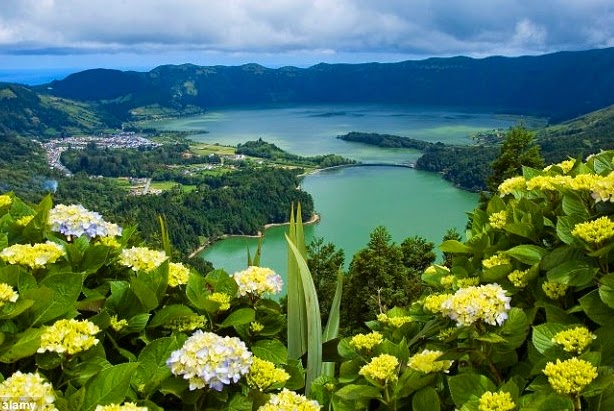
You probably heard of
Atlantis an island kingdom mentioned in Plato’s work. Controversy abounds
around the real versus mythical nature of this island. Atlantis is one of the
biggest mysteries in world history and literature.
What’s this to do with Portugal?... Well some say the Azores are the lost Atlantis… of course some others say Atlantis is now underwater and closer to the Bahamas, and still others that it never really existed. Those trying to push the Azores theory argue based on the location, its natural setting, and more recently even tried to use some underwater vestiges as extra evidence. Regardless of the real truth, the Azores and their pure untouched vegetation are a magical destination.
An archipelago with nine islands, the Azores are the result of a cultural melting pot which cooked over many centuries. Here you can see dolphins and whales flirting in a boundless ocean. In fact, the Azores are currently one of the world’s largest whale sanctuaries. You can spot more than 20 different types of cetaceans... that’s a third of the total number of existing species! Diving is another exciting activity available in the Azores. Day or night, sand or rock, caves or shipwrecks, you chose which diving experience you want… or you can also bring it down a notch and enjoy some calmer snorkeling in the crystal-clear waters around the islands. Finally if you want to pay homepage to those courageous whale hunters, the Azores are a world top destination for big-game fishing. The Azores are known among others for its large quantities of bluefin tuna and enormous blue and white marlins.
The Azores are much more than its surrounding water though. Of volcanic origin, its islands display blue and green lakes, deep green pastures, extinct volcanic craters, and rare plant species. One of its islands, Pico Island, is classified as World Heritage and boasts the highest mountain in Portugal (“Pico”). With its pristine vegetation, Mount Pico is home to some of the best views and hikes in the world. The volcanic origin of its islands also allows for some unique food experiences. In the Azores you can cook underground using the heat from special holes on the ground called “fumarolas”. Finally, other experiences include horseback riding, hiking, golfing, canyoning, bird watching, surfing and paragliding.
Whatever brought these nine islands together, made sure each of them kept its own identity. When you visit the Azores, make sure to save time to visit as many as possible. You’ll understand why being Atlantis or not is irrelevant, and how magical places still exist just a few hours away from Europe’s mainland.
Don’t wait until Atlantis disappears again: visit the Azores!
What’s this to do with Portugal?... Well some say the Azores are the lost Atlantis… of course some others say Atlantis is now underwater and closer to the Bahamas, and still others that it never really existed. Those trying to push the Azores theory argue based on the location, its natural setting, and more recently even tried to use some underwater vestiges as extra evidence. Regardless of the real truth, the Azores and their pure untouched vegetation are a magical destination.
An archipelago with nine islands, the Azores are the result of a cultural melting pot which cooked over many centuries. Here you can see dolphins and whales flirting in a boundless ocean. In fact, the Azores are currently one of the world’s largest whale sanctuaries. You can spot more than 20 different types of cetaceans... that’s a third of the total number of existing species! Diving is another exciting activity available in the Azores. Day or night, sand or rock, caves or shipwrecks, you chose which diving experience you want… or you can also bring it down a notch and enjoy some calmer snorkeling in the crystal-clear waters around the islands. Finally if you want to pay homepage to those courageous whale hunters, the Azores are a world top destination for big-game fishing. The Azores are known among others for its large quantities of bluefin tuna and enormous blue and white marlins.
The Azores are much more than its surrounding water though. Of volcanic origin, its islands display blue and green lakes, deep green pastures, extinct volcanic craters, and rare plant species. One of its islands, Pico Island, is classified as World Heritage and boasts the highest mountain in Portugal (“Pico”). With its pristine vegetation, Mount Pico is home to some of the best views and hikes in the world. The volcanic origin of its islands also allows for some unique food experiences. In the Azores you can cook underground using the heat from special holes on the ground called “fumarolas”. Finally, other experiences include horseback riding, hiking, golfing, canyoning, bird watching, surfing and paragliding.
Whatever brought these nine islands together, made sure each of them kept its own identity. When you visit the Azores, make sure to save time to visit as many as possible. You’ll understand why being Atlantis or not is irrelevant, and how magical places still exist just a few hours away from Europe’s mainland.
Don’t wait until Atlantis disappears again: visit the Azores!
Friday, 18 July 2014
AZORES – ADVENTURE HOLIDAYS

If you're looking for adventure, Azores is the right place to go! Not only
you'll be able to experience several different adrenaline-pumping
activities, you'll do so in beautiful and unique islands with amazing
sceneries. About 850
miles west of Portugal, Azores is a volcanic Atlantic archipelago that
offers all sorts of activities to fit everyone's liking.
You can visit Azores to relax, enjoy its beaches, explore the countryside and enjoy the scenery. However, you can also explore ravines and waterfalls, canoe in volcanic craters, or simply climb and cycle in different places of the islands. There are also some things more out of the ordinary, like swimming with dolphins and, if you're feeling particularly brave, diving with sharks.
Thursday, 22 May 2014
PORTUGAL'S BEST ROMANTIC HOTELS - HOTEL TALISMAN

At the historical center of Ponta Delgada, in Azores, we can find a charming hotel overlooking a beautiful park, the Hotel Talisman.
Its interior reveals the secret of good taste from open colors, textures and a hint of luxury, to the flow of the stairs and the warm glow of the winter garden. The old wing is elegantly furnished in a classical style, whilst the new wing offers accommodation in a more minimalist style.
Wednesday, 5 February 2014
BAY OF SAN LORENZO

The mostbeautiful
vineyards in the world are in Portugal and Italy. Things areas they are
and this is so. Vineyards like this Dorado called San Lorenzo Bay.
You cannot love the wine and stay in the cellar. An obvious truth that's
hard to believe during the first years of a wine lover. These first
years in which everything is beautiful and we collect corks and bottles
and we visit wineries. Majestic Wineries, designed by artists such as
Calatrava, Foster or Genhry. Wineries with paintings by Antoni Tàpies and Eduardo Chilida and rooms with more computers than one room at MIT. Wineries that are castles, where a man who is also winemaker speaks of the cup mix and you look and nods saying "aha".
Friday, 31 May 2013
The Best SPA's in Portugal - South and the Azores
TravelTailors offers you the relaxing and innovative properties of the best Portuguese SPA´s, located in naturally soothing landscapes; the finest options were selected, enhancing your beauty and well-being experience. Massages, trips and nature are in harmony in Lisbon, Alentejo and Azores.

Thursday, 11 April 2013
The Best SPA's in Portugal - South and the Azores
TravelTailors offers you the relaxing and innovative properties of the best Portuguese SPA's, located in naturally soothing landscapes; the finest options were selected, enhancing your beauty and well-being experience. Massages, trips and nature are in harmony in Lisbon, Alentejo and Azores.

Wednesday, 4 July 2012
The Best SPA's in Portugal - South and the Azores
| ||||||||||||||||||||||||||||||||||||
| ||||||||||||||||||||||||||||||||||||


Wednesday, 23 May 2012
Best SPA's in Portugal - South and the Azores - 6 dias
TravelTailors offers you the relaxing and innovative properties of the best Portuguese SPA´s, located in naturally soothing landscapes; the finest options were selected, enhancing your beauty and well-being experience. Massages, trips and nature are in harmony in Lisbon, Alentejo and Azores.
More information

More information

Subscribe to:
Posts (Atom)